
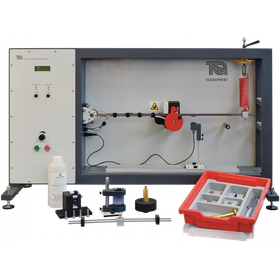
TM1016V Free Vibration and Forced Vibration Experiment Device
TM1016V Free Vibration and Forced Vibration Experiment Device
We will conduct experiments on free vibration and forced vibration, vibration damping, and vibration isolation using a simply supported beam made of steel (tool steel) or a spring-supported beam. The experiments involve two types: a simply supported beam with a "pin support at the left end and a roller support at the right end," and a spring-supported beam with a "pin support at the left end and a spring support at the right end." In the forced vibration experiment, a vibrator located at the center of the beam rotates two flywheels with offset weights, generating vibrations in the beam. The mass of the vibrator can be varied by adding weights below it. In the free vibration experiment, the beam is manually struck to induce vibrations. Additionally, we can conduct damping experiments using oil dampers and free/forced vibration isolation experiments using vibration isolation devices. The rotation speed of the flywheel in the vibrator (Hz, rad/s, rev/min) is displayed digitally, and a displacement sensor installed beneath the beam measures the beam's amplitude and frequency (natural frequency). An accelerometer inside the vibrator is positioned at the same location as the displacement sensor, allowing for a comparative verification of the acceleration waveform obtained during the experiment and the function-processed waveform (theoretical value). A wide range of experiments can be conducted, including the effects of load changes on natural frequency, calculation of the damping ratio ζ due to damper damping, and vibration isolation experiments on simply supported beams.
- Company:メガケム
- Price:Other
